 Perhaps the most iconic (at least in the Americas) shamanic textiles are those produced by the Shipibo people in Peru. This has been a difficult one for me because there is SO much information available on these textiles and all of it is AMAZING so it's hard to focus on just one thing. But I'll do my best!
Showing posts with label entoptic motif. Show all posts
Showing posts with label entoptic motif. Show all posts
Textiles and the Multi-Tiered Cosmos: Shipibo Textiles
Perhaps the most iconic (at least in the Americas) shamanic textiles are those produced by the Shipibo people in Peru. This has been a difficult one for me because there is SO much information available on these textiles and all of it is AMAZING so it's hard to focus on just one thing. But I'll do my best! 


Phosphenes, Entoptics, and a Tiered Cosmos
In the last post I mentioned that altered states of consciousness can result in the experience of phosphenes or entoptic images. These are geometric images or flashes of light that arise from the central nervous system and visual cortex. They are common to all humans (and possibly other animals). You can experience phosphenes by pressing on your closed eyelid. You'll see little illuminated squares, dots, ladders, and other motifs. That's a phosphene! When a phosphene or entoptic image appears in prehistoric art, it can be argued that the art is related to altered states of consciousness, trance, shamanism, or all three. These motifs appear in cave art, megalithic art, and many other forms of art including textiles.
 |
| Entoptic "floaters" |
Trance
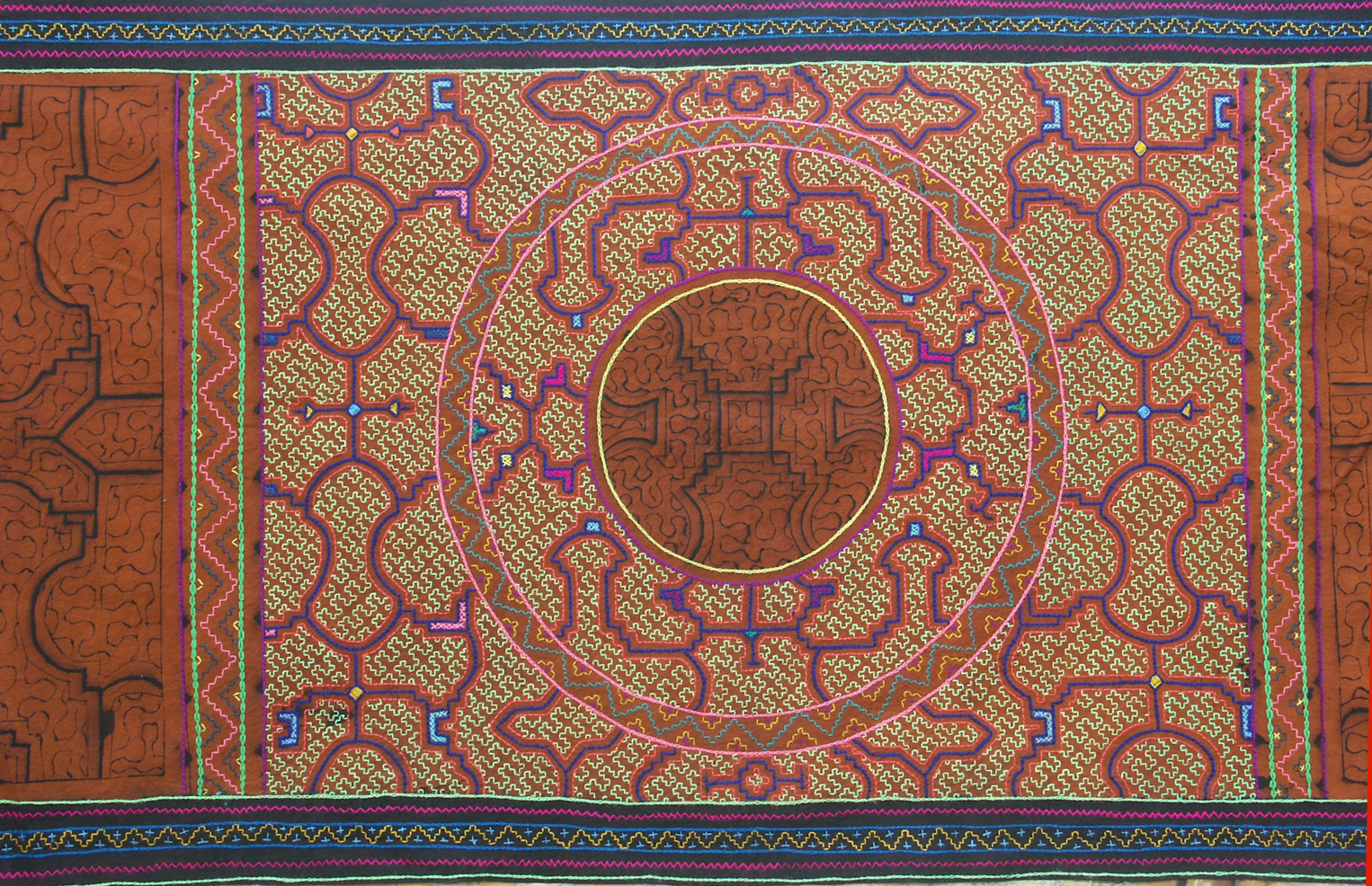 |
| Obvious entoptic image from a Shipibo textile (Peru) |
It is widely accepted that trance and shamanism played a role in prehistoric art and mark-making. Most scholars agree that the depiction of motifs on cave walls does not occur while the artist is actually in a trance state, but that the artist creates the artworks afterwards, illustrating her or his experiences during the trance. Weaving the motifs, though, may be another matter. As any weaver can attest, weaving is most certainly a repetitive action. Could the action of weaving, itself, be the induction method for the weaver to enter a trance state during which time she or he communicates with and travels through the spirit world? If that is the case, then the production of motifs occurs contemporaneously with, or within, the trance. If trance is indeed the origin of many traditional textile motifs, this may explain why they have been relevant and compelling for thousands of years.
Subscribe to:
Posts (Atom)