Showing posts with label prehistoric textiles. Show all posts
Ten Ancient Textiles in the News!
It's very unusual to find ancient textiles that have withstood the ravages of time. Most of them disintegrate within a few years.
BUT, sometimes the conditions are perfect for preservation of cloth.
Here's a great article about 10 ancient textiles, some of which I never even knew existed!
Check them out here.

Cannabis: Drugs and Textiles
This was meant to be a brief overview of the origin and spread of the use of Cannabis sativa for textiles and as a drug. Good lord! There's SO MUCH STUFF! Them ancient folk liked their hemp! I'm going to try to put it in a nutshell and break it up into sections, or this could go on forever. Eventually, I would like to investigate a correlation between the textiles and the drug, if there is any, in a sacred context.
![]() |
| Cave painting from Kyushu Island, Japan, dating to Jomon Period (14,000 to 300 BC). This is thought to be the earliest artwork in Japan. |
Perspectives: Part 1 - Me and Jack Cassin on Slit Weave Textile
Bohemia: Magical Textiles is trying something new. This is the first in a series of interpretations of a single textile by myself and a guest expert.
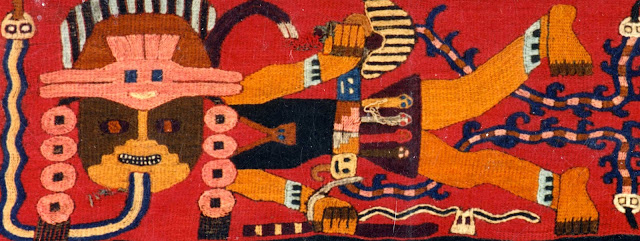
Textiles and the Multi-Tiered Cosmos: Huari Textiles of Peru
Huari Textiles
The People
The powerful and complex Huari Empire flourished from A.D. 750 to 1000. The empire was centered near the modern city of Ayacucho, Peru, and included a vast region of conquered coastal and highland lands across Peru. It's thought that the Huari, rather than force conquered peoples to submit to their religion, integrated local religions into an overarching ideology. The Huari were the first to use terraced agriculture in this hemisphere. They were sophisticated artists. Their textiles are considered to be some of the finest works of art from any era.
![]() |
| This guy. |
Trance
![]() |
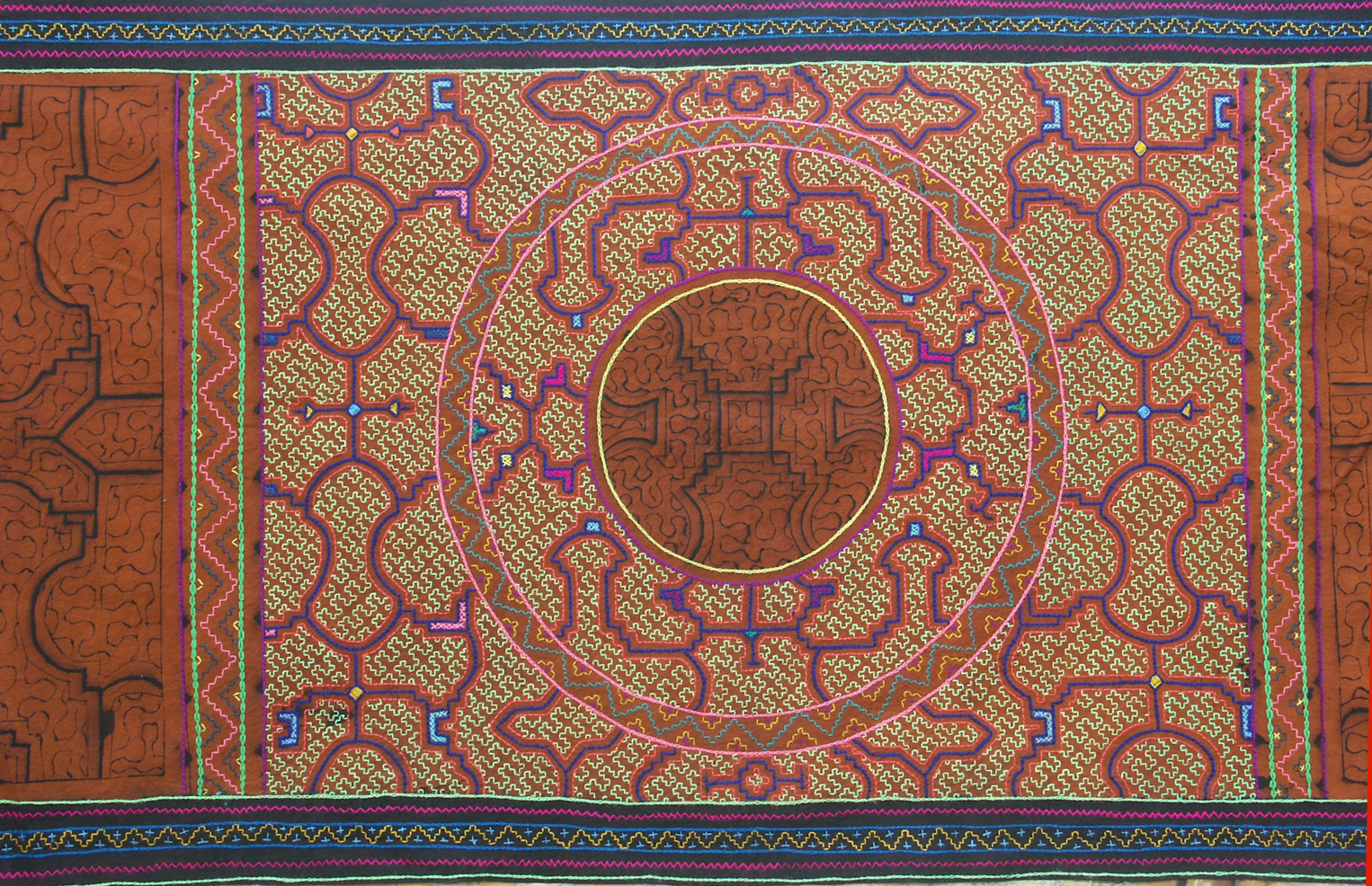
| Obvious entoptic image from a Shipibo textile (Peru) |
It is widely accepted that trance and shamanism played a role in prehistoric art and mark-making. Most scholars agree that the depiction of motifs on cave walls does not occur while the artist is actually in a trance state, but that the artist creates the artworks afterwards, illustrating her or his experiences during the trance. Weaving the motifs, though, may be another matter. As any weaver can attest, weaving is most certainly a repetitive action. Could the action of weaving, itself, be the induction method for the weaver to enter a trance state during which time she or he communicates with and travels through the spirit world? If that is the case, then the production of motifs occurs contemporaneously with, or within, the trance. If trance is indeed the origin of many traditional textile motifs, this may explain why they have been relevant and compelling for thousands of years.
The prehistory of textiles: Paleolithic
Textile production is one of the most ancient arts and is one of the most important factors in the survival of our species. Awls and eyed needles for sewing hides began to appear over 70,000 years ago. Amazing!
Subscribe to:
Posts (Atom)