|
| Samarkand Suzani |
Textile expert, Dr. Elmira Gyul says, "Admirers of traditional textiles value Suzanis for their vigorous coloring and original patterns, natural materials and refinement of embroidery skills." I love that description! Vigorous!!! So true!
"Suzani" refers to an embroidered cloth produced in Central Asia. Suzani is an Iranian and Tajik word meaning "needle." Large suzanis are very popular, and were/are used as wedding coverlets and canopies, funeral drapes, and wall decor. Smaller embroidered items include wall hangings, bags, purses, prayer mats, clothing for people and animals, food covering, etc.
Production is centered in Uzbekistan, Tahikistan, and Turkmenistan, mainly in the towns of Bokhara, Samarkand, Nurata, and Tashkent. Each town developed unique textile techniques and traditions that are readily discernible today. Samarkand suzanis typically depict large, repeated circle/floral motifs and are very often black and red on a white or beige ground. To me, they are the moodiest, most psychedelic, and most visually striking of all the styles. The textile shown here is a very large, relatively inexpensive vintage Samarkand suzani purchased on Ebay in 2011. The ground is lightly stained cotton and silk weave, and the motifs are created with cotton thread embroidery. The piece is constructed in three strips that were embroidered separately and then joined together.

Western Central Asia is located along the Silk Road, in use from around 2,000 b.p and linking China to the Mediterranean. Silk, horses, spices, and other luxury goods were brought by caravan along this road, facilitating the spread of culture and knowledge across the continent. Most trade goods changed hands several times in the oasis bazaars along the route. Local nomads provided fresh horses and camels and served as guides across the desert and mountain passes.
The oases, mountains, and rivers in Central Asia attracted all sorts of people from all over the continent. This part of the world is an incredible mix of ethnic groups and lifeways. The predominant ethnic groups of this region are descendents of wave after wave of nomadic Turkic and Mongolian nomads, who came into the area in search of pasture. Some nomads mixed with the sedentary inhabitants of the oasis towns. Today, these include the Kazakhs, Kyrgyz, Turkmen and Uzbeks. Tajiks are descended from the original Indo-European inhabitants of the area and speak a Persian language. Arab peoples, whose ancestors brought Islam to Central Asia in the early 700s, together with Russians, and a range of minority peoples, make up the remainder of the population.
Nomads coming in from northern central Asia lived in yurts and brought with them woven, felted, and embroidered rugs, hangings, bags, and other textiles created from the wool of their animals. The designs of the textiles were passed down from mother to daughter and came to represent membership in a family group. The sedentary groups of central Asia produced beautiful, complex ikats. This makes a lot of sense, as the ikats were produced on (relatively) stationary looms, while the embroideries and felts were more portable, and could be worked on anywhere, even while traveling. Not surprisingly, Central Asia became a hub of the world's most beautiful and valuable textiles.
Textile Creation
One woman draws (freehand) the pattern onto strips of linen, velvet, silk, or cotton cloth. These are sometimes lightly tea-stained for a beige tint. The embroidery is carried out by a group of women. After the embroidery is completed on each strip, they are sewn together to form a large finished piece. Suzanis were/are a major part of a girl's dowry. When a girl was 8 years old or so, she and her family would begin producing suzanis in preparation for her wedding.
For large suzanis, several of the fabric strips are first sewn loosely together and the pattern is drawn on them; then they are taken apart so that two or more family members or friends can work on the embroidery simultaneously. Later when the panels are rejoined, the pattern parts may not match perfectly, and extra stitches may be added in the areas along the seams.
It appears that this particular suzani was sewn in three strips that were joined together.
 |
| Detail showing the seam where strips of embroidered cloth have been rejoined |
The motifs
Their true sense are often hidden from us. The important role of Suzanis are connected with the belief to the magic forces of their patterns. Scholars have already marked the common protective value of suzani embroideries, such as their usage in ceremonial and cult practice as protective force. The patterns within the embroideries also carry the same protective meaning, as well as having their own unique historical interpretations. Each element is a part of the Universe, and the composition is a image of the World, with harmony and balance, sometimes unachievable in real life.
Suzanis of each regions or center have their own local features. Astral and solar symbols predominate in Tashkent and partly in Samarkand Suzanis. In Tashkent Suzanis are known as palak (heavens, arab.), oy-palak (moon heavens) or yulduz-palak (star heavens).The images of heavenly stars are the ancient tradition, which roots go to the ancient strata of culture. The artisans considered these patterns provided the heaven protection. Step-by-step old cults were replaced by the new ones – as a result, astral symbols transformed into vegetative and floral symbols (Surkhandarya and Samarkand Suzanis, for example). Transformation of solar forms into vegetative symbols reflects the change of religious representations in a society and depreciation of old symbols.
In each case Suzani drawings is the image of an ideal universe, unity of magic and beauty. Suzani embroidery is the unique phenomenon of late medieval culture of Central Asian’s cities and villages; it has kept the ancient archetypes and medieval symbols in the patterns and has reflected interaction of various historical and art traditions.
 |
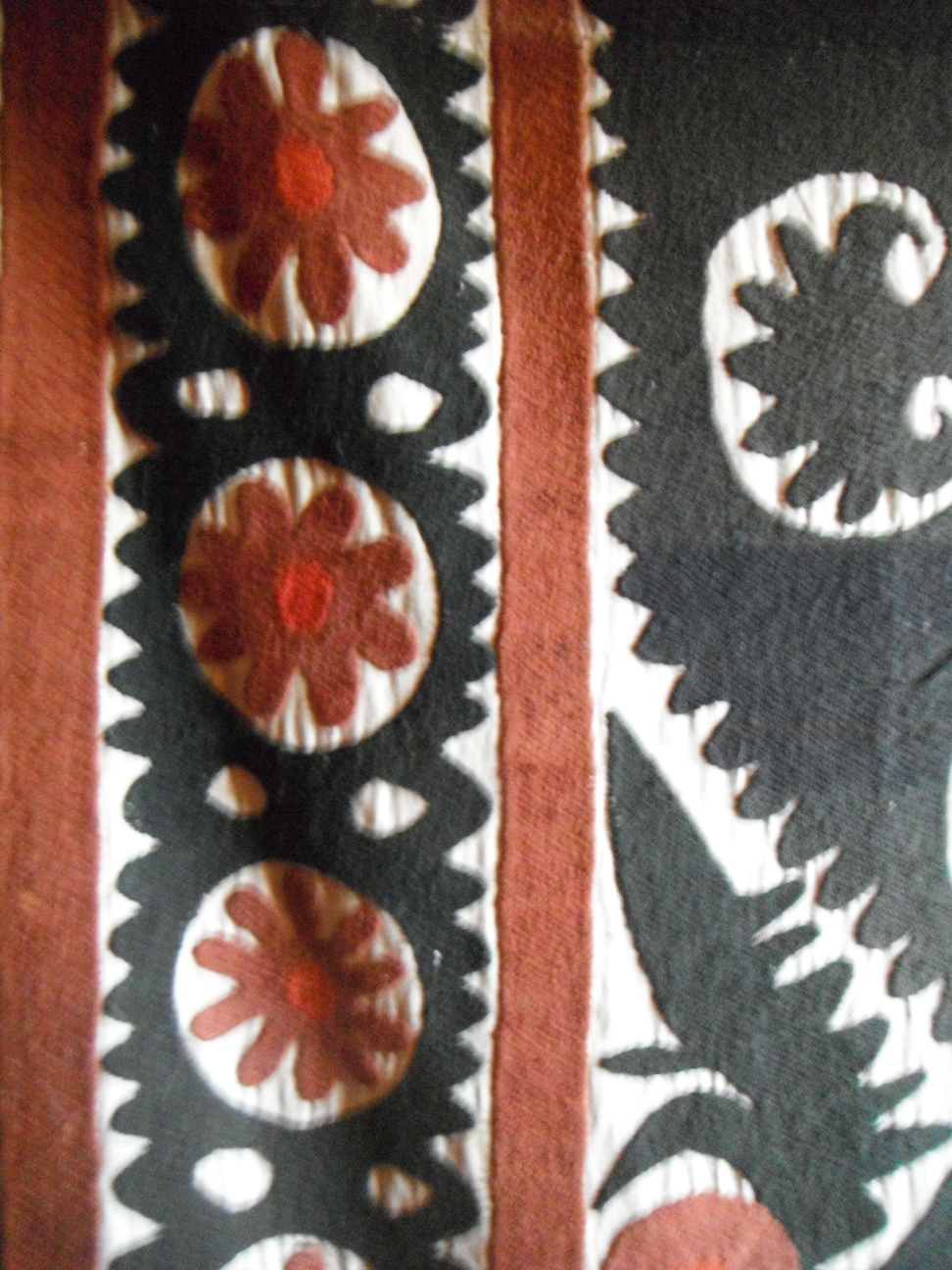
| Detail showing flowers within the border strip |
The piece is covered in floral and plant-like or leaf-like designs.According to Dr. Gyul, these images are vegetal interpretations of more ancient celestial motifs. I'd go a step further. Clearly, this example contains entoptic images including radials, zigzags, repeated motifs, and nested or concentric circles. It's difficult to discern from these pictures, but the Islam moon and star appears to be present as well, within the larger circles. Also, could that be a bird in the lower right corner of this picture? If Dr. Gyul is correct in her assessment that these motifs depict an ordered or harmonious universe, referencing the stars/heavens, then I suggest that the embroidery reflects a neurologically based tiered cosmos. This may be supported by the fact (at least according to the Textile Arts Center Blog), that shamanism is the domain of women, and embroidery is considered a "vital protection against evil." This insinuates that the embroideresses have access to another cosmic realm.
To me, this suzani certainly imparts a sense of peace and unity with the world.